The Flores people debate: A 'breakthrough' story and a cautionary tale.In 2004, a team of australian and indonesian scientists reported on their discovery of the remains of a skull and a jaw of a small size hominid which lived on the island of Flores, Indonesia, some 18000 years ago (
P. Brown et al., 2004. A new small-bodied hominin from the Late Pleistocene of Flores, Indonesia. Nature, 431, 1055-1061). With the skeleton remains, they found advanced stone tools usually used by early modern humans. Their discovery was followed in April 2004 by a publication featuring an endocast of the skull (
D. Falk et al. 2005. The Brain of LB1, Homo floresiensis. Science, 308(5719):242-245). The endocast shows a surprisingly small brain of 417 cc compared to that of a modern human brain which averages 1450 cc. The co-existence of a small size individual (projected size about one meter) with advanced tools usually used by hominids having big brains led the scientists to postulate a new species,
Homo floresiensis or 'hobbitt' and to present their discovery as a
breakthrough in the study of human origins. Despite many
skeptical voices raising the possibility that the new species might as well be deriving from a pathological condition known as microcephaly, the researchers persevered and published recently more findings with more remains which, they say, come from 9 small size individuals including another jawbone similar to the original but which is 3000 years more recent than the original.
Still, this didn't quell the skeptics who challenge the methodology and contend that not only evidence for Microcephaly was not completely adressed and eliminated but also the evidence for a new species still shaky and that the authors are not sure about the ancestor species (
E. Culotta, 2005. Human origins. Battle erupts over the 'hobbit' bones, Science, 307(5713):1179 AND, Paleoanthropology: New 'Hobbits' Bolster Species, But Origins Still a Mystery, Science, 310(5746):208a-9a. ALSO, J.Weber et al. 2005. Comment on ‘‘The Brain of LB1,Homo floresiensis’’, Science, 310: 236b.)Some critics say that small size individuals with a small brain could not have invented nor even used tools measuring about 12 cm and that the existence of the tools in the cave could be explained by soil movements and accidents. Some other critics maintain that individuals with microcephaly have brains which average the size of the Flores endocast and that these individuals are deeply handicapped, they cannot even walk and they are mentally retarded, lets not talk about using advanced tools.
Most of the arguments displayed in the controversy did not go into the details of two major implications of the new species theory, one epistemological and one moral.
The new species theory challenges some deep rooted aspects of the current explanation of human origins; namely the fact that the actual human species is the sole outcome of hominid evolution and that this evolution was accompanied by a rapid increase in brain size as considered relatively to the size of the body. Although scientists recognize that there is no direct evolutionary advantage to the increase in the size of the brain, they insist on the fact that the
increase in brain size during hominid evolution seems to hold the key for increased variations in the potential displayed by an individual in his interactions with its environment leading to inventions of new expertises and tools. Since the proponents of the new species theory wrote that
floresiensis might have descended from
erectus than shifted the descent hypothesis to
australopithecus, we are entitled to ask with the most vocal critic of the new species theory, prof. T. Jacob: As both ancestors had bigger brains, could evolution be reversible ?
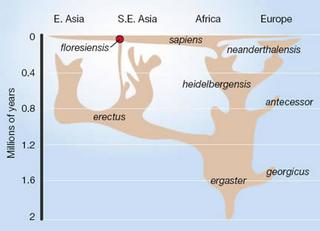
This figure, taken from the Prehistoric Cultures web page of the University of Minnesota Duluth, shows the probable (or improbable) descent of Homo floresiensis.
The new species theory tells us that the Flores people lived some 12000 years ago, this is like yesterday in evolutionary history. If we, sapiens, were to live with the Flores people, how could we have looked at them ? Could we have looked at them as our equals in humanity or as a different species ? Knowing human nature, my bet is that our perceptions, being very normative, we would have discriminated heavily against these people, even if they were our equals in intelligence and technology, which I really doubt. But equality in intelligence and technology are not criteria for equality in rights, very often, in everyday life, immediate perceptions override such criteria.
The new species theory challenges our uniqueness as humans. Suddenly, we are forced to think that we are not the only living human creatures who possess intelligence and expertise. But we are uncertain about this fact. For the new species theory to become more plausible, more evidence is needed. The beauty of science is that it is at the same time creative and conservative. To overthrow a whole edifice, the edifice of human uniqueness and its particularities, the edifice of many sciences, we need more than few skeletons, two jawbones and some tools found in an indonesian cave.
In reviewing the press releases and the scientific articles in specialised journals, it appeared to me that the scientific journal which initially published the story is less cautious than the mainstream media covering the story. Actually, many reportings of the Flores people story were restrained and well informed, the best being that of John Noble Wilford of the new York Times (oct.12th, 2005).
My guess is that mainstream media, being aware of the potential and controverisal use of the Flores story by creationnists and anti-creationnists, were careful to report accurately and in a more balanced way about it while its coverage by Nature, a scientific journal, was, in my opinion, flately enthusiastic and one-sided. Indeed, most papers critical of the new species theory were published in the journal Science. Read here for the fun about the strange coincidence of the publishing of the Nature article and of the critical articles in the journal Science.
But this is not the first time Nature goes to such extremes in order to stay ahead in breaking big science stories and this is not the first time Anthropology, a science in search of a renewal and a new breath, delves into controversy.


 Posts
Posts


